
Jan 9, 2024 | Personal
“They’re just going in circles for two hours.”
Ah, I’m here again.
This is the dance you must do when you tell people you like NASCAR.
I, a seasoned veteran of the motorsportian arts, have heard this any time I admit I like watching the races.
By now, I know exactly how this will go.
I’ll say, “Well, it’s actually more complicated than that. There’s a lot of strategy involved in racing position, pit stops, and…”
They’ll nod while looking around the room to see if anyone can save them from this car wreck of a conversation.
I’ll continue. “…and the engineering required to get the cars that fast is actually…”
They’ll interrupt me to ask if I get blackout drunk at every race. Then, check my mouth to see if I have all my teeth.
It’s a losing battle.
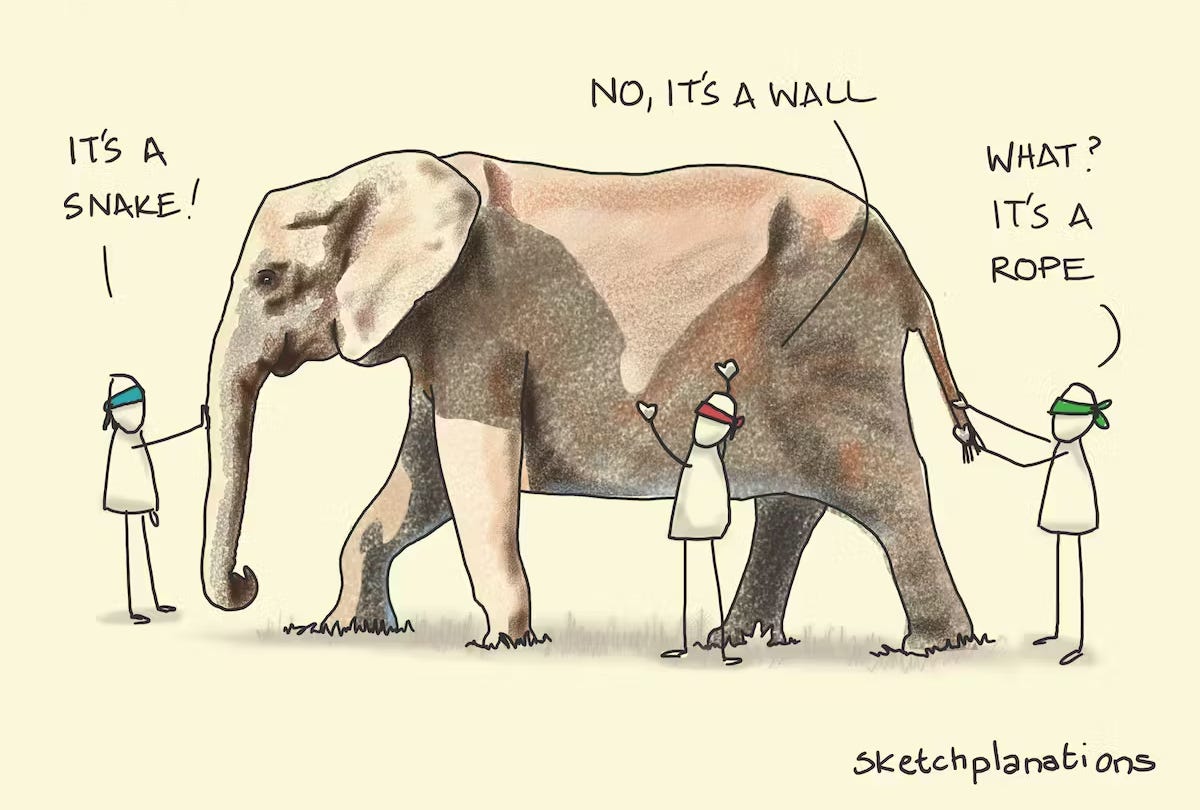
Here’s a famous Indian parable.
A group of blind men traveled down the path to their village. As they neared its edge, they encountered a great object blocking their way.
One man mustered the courage to walk up to the object to feel what was in their way. He held out his hand, hesitating for a moment, before grazing the side of the object with his palm. He jumped back and declared that a great thick snake was standing in their way.
A second man, realizing that a great snake would have already attacked them, was skeptical of this statement. He walked over and boldly planted his hand on the object. A few seconds later, he described the object as a fan and suggested they use it to keep them cool for the rest of the journey.
A third man, now confused and agitated by the conflicting stories of his friends, walked over to the object slowly. Like the men before him, he felt the object but now described it as nothing more than a large tree trunk.
Murmurs broke out among the group.
On and on, each blind man touched the object and told a different tale about what they had encountered.
None of them realized it was an elephant.
On November 7, 1940, the Tacoma Narrows Bridge began to twist violently.
Then, it started to tear.
Then, it collapsed.
Nobody expects bridges to collapse, but nobody expected this bridge to collapse.
It was designed by the Avengers of architectural engineering, and their Iron Man was Leon Moisseiff. He created the bridge using the deflection theory, which suggested that lighter, more flexible structures could withstand strong winds better than rigid ones.
It was slender and elegant. The most technologically advanced bridge ever created, in theory.
The bridge opened to the public on July 1, 1940, amidst much fanfare. The academic paper that accompanied the construction was lauded as the most important theoretical advance in bridge engineering of that decade.
There was one problem.
The bridge wasn’t rigid enough. It tended to move up and down in windy conditions, then start twisting. This oscillation wasn’t a fun little quirk. Instead, it was a glaring design oversight that would prove fatal.
The bridge collapsed 129 days after it opened.
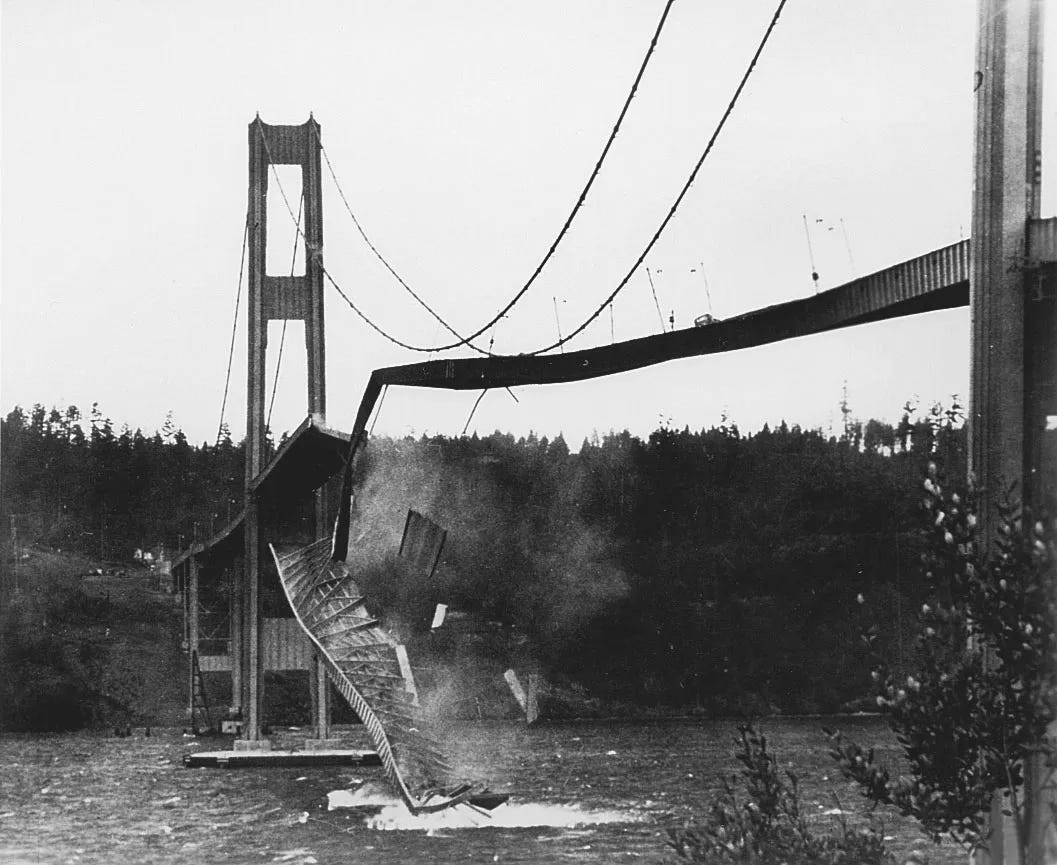
Collapse of the Tacoma Narrows Bridge, Washington state, 1940.
This shouldn’t have happened. It was designed by the best engineers, using state-of-the-art engineering theory.
As one recounting puts it:
“Moisseiff’s design, while pushing beyond the boundaries of engineering practice, fully met the requirements of accepted theory at the time.”
It worked, in theory.
I’ve come to realize that if I think something is dumb, I probably don’t understand it.
Sure, sometimes something really is dumb, but that shouldn’t be my default reaction. Often, if something seems dumb, it’s because I’m missing something.
So now, I try to ask myself:
Thanks to for refining this post!
Get Notified When Articles Are Published